
Week 10: Additional Research
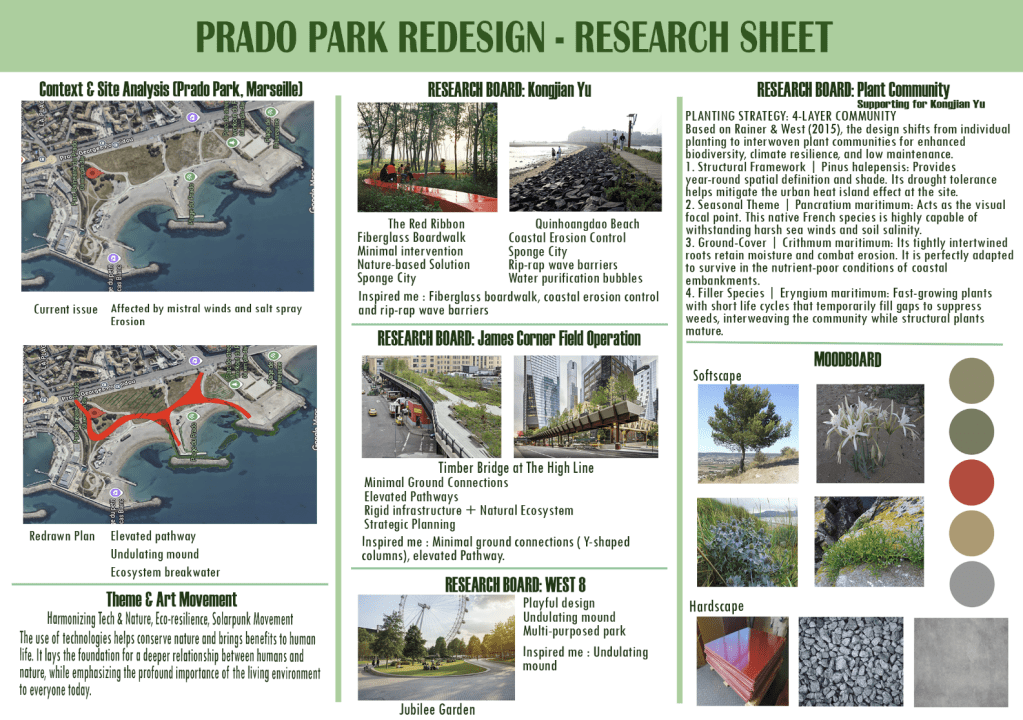
This research is to support Kongjian Yu research. I decided to create the ecosystem wave barrier.
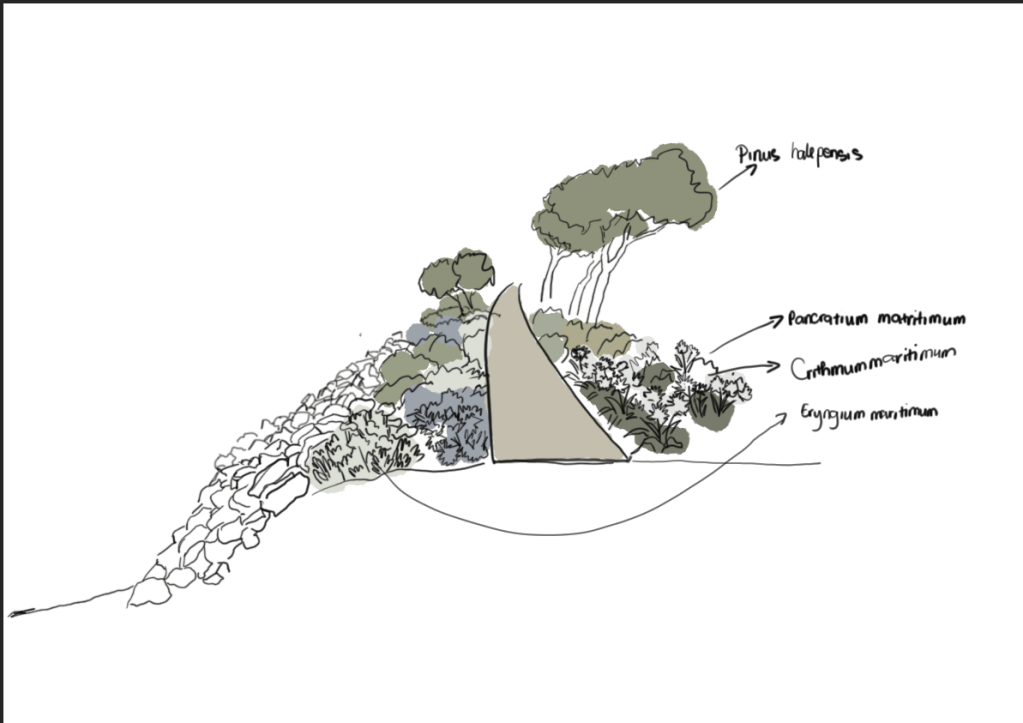
According to Rainer and West (2015), plant design needs to shift from cultivating individual plants to designing tightly interwoven communities because they have abilities of maximizing biodiversity, self-sustaining & low maintenance and climate resilience. This theory includes 4 layers of plants which are structural and framework plants, seasonal theme plants, ground-covering plants and filler species. Structural and framework plants play a role of shape space, provide shade, and create a stable visual structure year-round, even in winter when other layers have withered which are trees with clearly defined architectural forms, while seasonal theme plants It is the most eye-catching layer which include clusters of flowering plants, ornamental plants. Besides, the ground-covering layer was mentioned as an important part of the plan communities whose roots intertwine tightly to completely cover the ground. It helps retain soil moisture, prevents weed seeds from germinating, and combats erosion. Finally, the Filler layer includes plants with short life cycles and rapid growth which play the role of reservation, keeping the place for the plants from the structure layer and seasonal theme layer not yet mature. This helps prevent the growth of weed.
Based on the supporting research, I design the ecosystem in the breakwater section which also has 4 layers of plants. For the structural layer, I use Pinus Halepensis which has drought tolerance and creating shade reduces the urban heat island effect (Forests 2020). This support for the climatic characteristics of Prado Beach are described above. I chose Pancratium Maritimum for the seasonal theme plant because it is one of native plants in France and capable of withstanding soil salinity and sea winds (Horticultura 2025). For ground-covering plants, I want to choose a plant which can adapt to nestle among the cliffs and coastal embankments exposed to strong salty winds, and survival strategies in nutrient-poor soil conditions is Crithmum Maritimum (de la Riva et al., 2016). Then to fill the gaps between the ground cover and the structural layer, interweaving with other species to create a cohesive, naturally lush plant community, I choose Eryngium maritimum (Cortés-Fernández et al., 2022).
Reference:
Harrouk, C. (2019). LAVA+Aspect design the Central Park of Ho Chi Minh City. [online] ArchDaily. Available at: https://www.archdaily.com/922558/lava-plus-aspect-design-the-central-park-of-ho-chi-minh-city [Accessed 10 Mar. 2026].
Florian, M.-C. (2025). Kongjian Yu, Creator of the Sponge City Concept, Passes Away in Brazil Plane Crash. [online] ArchDaily. Available at: https://www.archdaily.com/1034437/kongjian-yu-creator-of-the-sponge-city-concept-passes-away-in-brazil-plane-crash (Accessed 10 Mar. 2026).
Ghisleni, C. (2024) ‘Urban Landscape as an “Art of Survival”: An interview with Kongjian Yu, the Advocate of the Sponge Cities Concept’, ArchDaily, 23 June. Available at: https://www.archdaily.com/1017697/urban-landscape-as-an-art-of-survival-an-interview-with-kongjian-yu-the-advocate-of-the-sponge-cities-concept (Accessed: 10 Mar 2026).
ArchDaily (2013) ‘Red Ribbon Park / Turenscape’, ArchDaily, 7 November. Available at: https://www.archdaily.com/445661/red-ribbon-park-turenscape (Accessed: 15 Mar 2026).
Landezine (2012) ‘The Qinhuangdao Beach Restoration by Turenscape’, Landezine, 16 February. Available at: https://landezine.com/the-qinhuangdao-beach-restoration-by-turenscape/ (Accessed:15 Mar 2026).
Turenscape. (2011, August 30). The Qinhuangdao Beach Restoration by Turenscape. Landezine. https://landezine.com/the-qinhuangdao-beach-restoration-by-turenscape/
Camarero, J. J., Sánchez-Salguero, R., Ribas, M., Touchan, R., Andreu-Hayles, L., Dorado-Liñán, I., Meko, D. M. and Gutiérrez, E. (2020) ‘Biogeographic, Atmospheric, and Climatic Factors Influencing Tree Growth in Mediterranean Aleppo Pine Forests’, Forests, 11(7), p. 736. Available at: https://doi.org/10.3390/f11070736.
Pouris, J. and Rhizopoulou, S. (2025) ‘Metabolic and Stomatal Traits of Pancratium maritimum L. (Sand Daffodil) Subjected to Induced Salinity’, Stresses, 5(1), p. 14. Available at: https://doi.org/10.3390/stresses5010014.
de la Riva, E. G., Lloret, F., Pérez-Ramos, I. M., Marañón, T., Navarro-Fernández, C. M., Olmo, M. and Villar, R. (2016) ‘The importance of functional diversity in the stability of Mediterranean shrubland communities after the impact of extreme climatic events’, Journal of Plant Ecology, 10(2), pp. 281–293. Available at: https://doi.org/10.1093/jpe/rtw027.
Cortés-Fernández, I., Sureda, A., Adrover, M., Caprioli, G., Maggi, F., Gil-Vives, L. and Capó, X. (2022) ‘Antioxidant and anti-inflammatory potential of rhizome aqueous extract of sea holly (Eryngium maritimum L.)’, Ecology and Evolution, 12(7), e9164. Available at: https://doi.org/10.1002/ece3.9164.
Field Operations (no date) James Corner, FASLA, PLA. Available at: https://www.fieldoperations.net/studio/people/james-corner-fasla-pla (Accessed: 10 Mar 2026).
Mazade, K. (2023) ‘SOM connects block-long glulam bridge to the High Line’, Dezeen. Available at: https://www.dezeen.com/2023/05/18/som-block-long-glulam-bridge-high-line/ (Accessed: 10 Mar 2026).
Skerl, U. (2024). Office Profile: West 8. [online] Landscape Architecture Platform | Landezine. Available at: https://landezine.com/office-profile-west-8/ (Accessed 15 Mar. 2026).
Landezine (2015). Jubilee Gardens by West 8. [online] Landezine. Available at: https://landezine.com/jubilee-gardens-by-west-8/ (Accessed 15 Mar. 2026).
Reina-Rozo, J. D. (2021). Art, energy, and technology: The Solarpunk movement. International Journal of Engineering, Social Justice and Peace, 8(1), 47-60. https://doi.org/10.24908/ijesjp.v8i1.14292.(Accessed: 20 Mar 2026).
Gillam, W.J. (2023) ‘A Solarpunk Manifesto: Turning Imaginary into Reality’ , Philosophies, 8, article 73. Available at: https://doi.org/10.3390/philosophies8040073 (Accessed: 20 Mar 2026).
Greenroofs.com (2022). Gardens by the Bay, Supertrees. [online] Greenroofs.com. Available at: https://www.greenroofs.com/projects/gardens-by-the-bay-supertrees/ (Accessed 20 Mar. 2026).
Archdaily (2012). Gardens by the Bay / Grant Associates. [online] ArchDaily. Available at: https://www.archdaily.com/254471/gardens-by-the-bay-grant-associates (Accessed 22 Mar. 2026).
Rampal-Guiducci, J. (2024) ‘Prado beaches: the City of Marseille carries out early reprofiling’, Gomet’, 3 March. Available at: https://gomet.net/plages-du-prado-un-reprofilage-precoce/ (Accessed: 10 Mar 2026).
City of Marseille – 6th and 8th Arrondissements (2025) ‘Master plan for the development of the South Coast’, Ville de Marseille. Available at: https://mairie-marseille6-8.fr/votre-mairie/actualites/plan-guide-damenagement-du-littoral-sud(Accessed: 10 Mar 2026)
Ville de Marseille (2018) Program study for the global enhancement of the Prado Seaside Park in Marseille: Phase 1 – Diagnostic study. Marseille: Ville de Marseille. (Accessed: 10 Mar 2026)
Bibliography
World Bank Group (2024) Climate Change Knowledge Portal: Vietnam. Available at: https://climateknowledgeportal.worldbank.org/country/vietnam (Accessed: 30 March 2026).
Saunders, W. S. & Yu, K. (2013) Designed ecologies : the landscape architecture of Kongjian Yu. 1st ed. [Online]. Basel: Birkhäuser.
Architizer, (n.d.). What Is Solarpunk Architecture and How Does It Fit Into the Built Future? [online] Architizer. Available at: https://architizer.com/blog/inspiration/stories/solarpunk-architecture-and-the-built-future/ (Accessed: 15 Mar 2026).
Republic of the Bees, (2008). From Steampunk to Solarpunk. [online] Republic of the Bees. Available at: https://republicofthebees.wordpress.com/2008/05/27/from-steampunk-to-solarpunk/ (Accessed: 22 Mar 2026).
World-Architects, (n.d.). Qinhuangdao Beach Restoration: An Ecological Surgery. [online] World-Architects. Available at: https://world-architects.com/en/turenscape-haidian-district-beijing/project/qinhuangdao-beach-restoration-an-ecological-surgery (Accessed: 10 Mar 2026).
Sousa, M. (2019) ‘Sponge City: Nature is the solution for floods’, ArchDaily Brasil. Available at: https://www.archdaily.com.br/br/924346/cidade-esponja-a-natureza-e-a-solucao-para-inundacoes (Accessed: 10 March 2026).
Dreith, B., (2023). Concrete-based urban areas “will fail” says Kongjian Yu. [online] Dezeen. Available at: https://www.dezeen.com/2023/10/19/sponge-cities-flooding-interview-kongjian-yu-turenscape/ (Accessed: 10 Mar 2026).
The High Line, (n.d.). Connections. [online] The High Line. Available at: https://www.thehighline.org/connections/?utm_source=highline&utm_medium=website-design&utm_content=connections-announcement&utm_campaign=connections-announcement (Accessed: 10 Mar 2026).
Field Operations, (n.d.). High Line Moynihan Connector. [online] Field Operations. Available at: https://www.fieldoperations.net/project/high-line-moynihan-connector (Accessed: 10 Mar 2026).
West 8, (n.d.). Jubilee Gardens. [online] West 8. Available at: https://www.west8.com/projects/jubilee-gardens/ (Accessed: 10 Mar 2026).
Evaluation
This semester I have developed many skills and techniques including old and new things. Choosing a theme and topic was not too difficult but the real challenge lies in meeting the deadline, doing everything at once. I tried my best to do everything I wanted but not all of the things went right as I expected. Studying landscape architecture made me wonder about my decision because it made me feel down and burnout a lot, however I keep doing this journey.
At the beginning of the journey, I was struggling with doing deep research and critical analysing. Reading research from online resources is easy but finding academic resources is difficult because not all of the resources I need are available in the university library. To improve it, I spent more time on finding similar research of what I needed and additionally I do primary research to gain real-life experience when I can see how people use a park. Sketching down the landscape and ideas helps me a lot in generating my idea to other people, in parallel improving my sketching skills. Plus, doing enough research is also important when I keep reading more research but not document about it and the more I read the more ideas I have even though have enough time for this. If I did this again, I would document everything first before turning into new research because it allows me to spend time more efficiently.
Stepping in the process of practice, I did much research to support old research before. This made me realize that time management is extremely vital for having enough time for unexpected tasks. Because of not controlling time very well, I allowed doing research to take time for practical works, then I did not have enough time for making models. If I could start it again, I would distribute time more logically by creating a time limit for every task. This allows this task to not affect the productivity of other tasks.
My outcome did not turn out as well as I expected, I could not do the models so aesthetically for showcasing, because I made the models too big, as a result I did not have time to complete it into a professional version as I expected. However, I did enjoy the process because it helped me to gain more experience that I could use for next semester. For example, I used many types of glues that I know which type of glue works well on foam and cardboard. If I could return, I would change to a medium size that I can control the material and time more well.
Overall of this semester, I did improve my skills a lot in both doing research and practical work. I am happy with my final outcome although it did not turn out quite well. This process makes me happy with the imperfections because I tried my best. If I could do this semester again, I would plan the process for completing my final outcome sooner for every unexpecting task to come in.
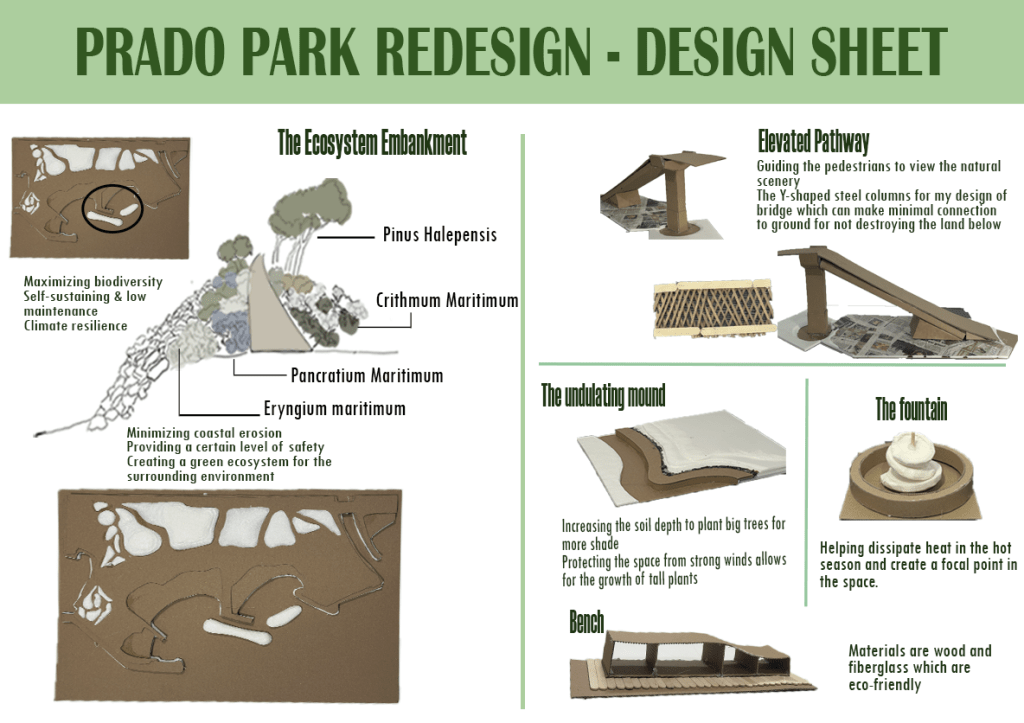
Final Design sheet:
 Phuong Vi Nguyen