
Week 3: Action Plan & References and Visual Research
- Section 1: Action Plan
I found that Action Plan includes both long-term and short-term goals, which are essential for personal development, such as the skills I currently possess and those I lack. These skills are especially important for my upcoming courses and future career.
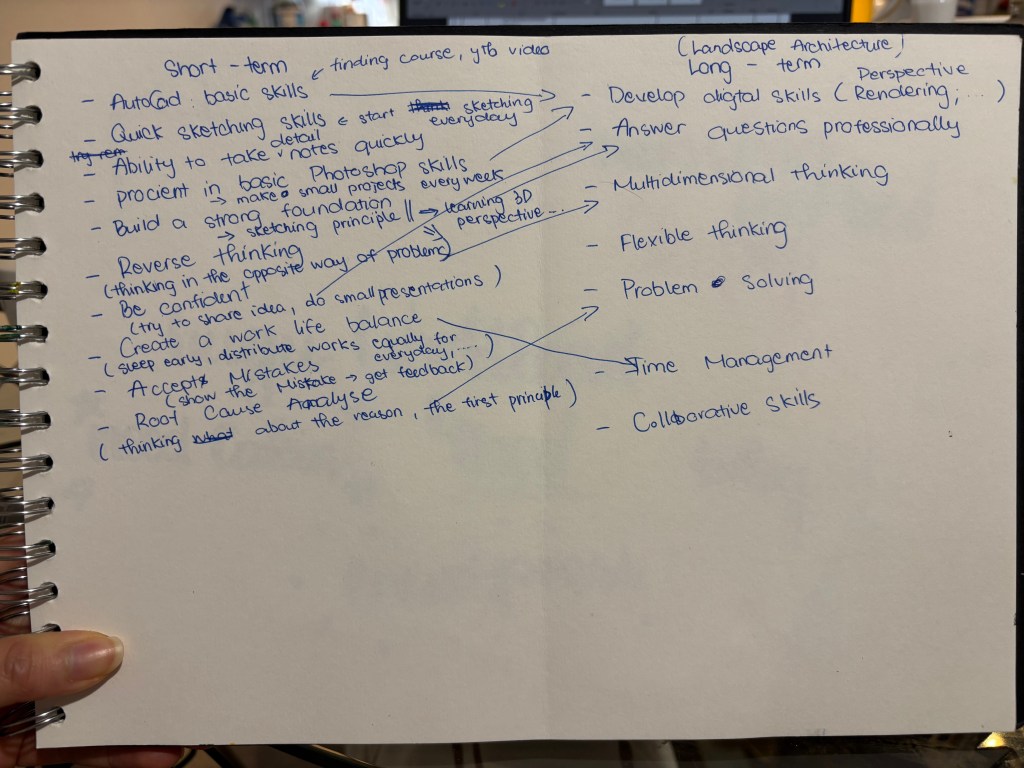
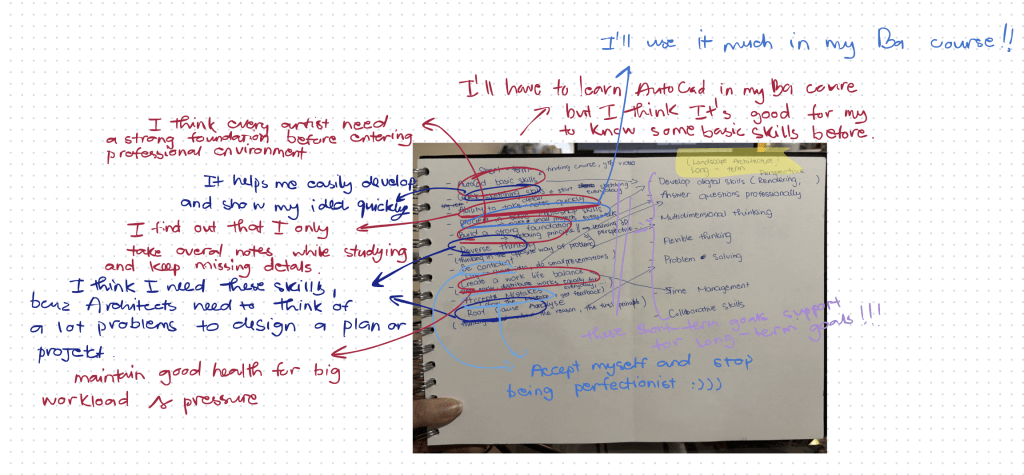
Then based on these short-term and long-term goals, I need to create an action plans tables to force myself to do and support myself how to achieve them.
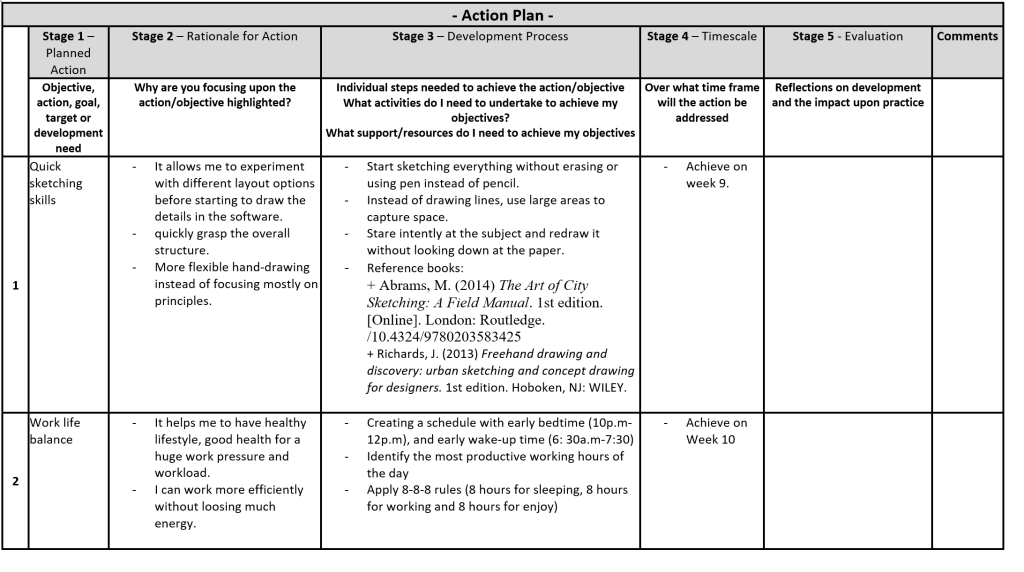
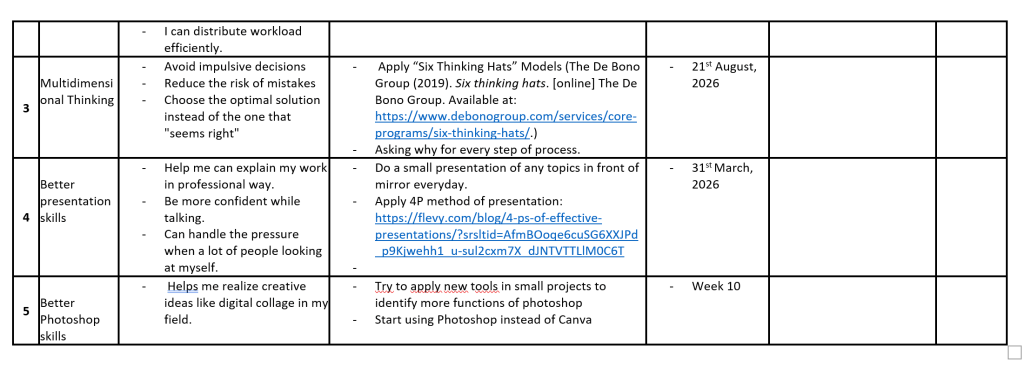
Selecting the necessary skills is quite time-consuming because I don’t want to create a huge workload that would put pressure on me or cause stress.
I think this is a comprehensive personal development strategy, closely integrating professional skills and life management thinking, encompassing professional skills for both learning and life (work-life balance) because good health is essential for developing other things.
- Section: Reference
I learnt about writing references in essays is important to support my idea and thesis. I dont really good at writing reference but I will try my best, because it is neccessary for my academic learning.
I also learn about visual research which blends secondary sources with personal ideas to produce original designs. It helps understand the context of any image and is essential before referencing it.
Then I wrote an paraphrasing about using Bitunem as a roof material for my cafe shop.
The use of bitumen as a roofing material for buildings, especially modern designs with low-slope roofs, offers many outstanding advantages in terms of technical performance and durability. Bitumen’s greatest strength lies in its ability to create a perfect waterproof membrane. When combined with synthetic roofing felts, bitumen is treated with a bonding compound, solvent, or gas torch heat welding. This process allows the material layers to melt and fuse together, forming a uniform, airtight surface. As a result, the joints become completely watertight, eliminating the risk of leaks even in harsh weather conditions. Unlike traditional tiles or metal roofing that require a steep slope for drainage, bitumen systems are extremely suitable for flat roofs or those with very low slopes. Bitumen’s physical properties give it a certain degree of flexibility, allowing the material to expand and contract with small movements of the building structure without cracking or delamination(Schunck et al., 2003).
Reference: Schunck, E, Oster, HJ, Barthel, R, Kießl, K, & Kießl, K 2003, Roof Construction Manual : Pitched Roofs, Walter de Gruyter GmbH, Basel/Berlin/Boston. Available from: ProQuest Ebook Central. [18 February 2026].
- Visual Research:
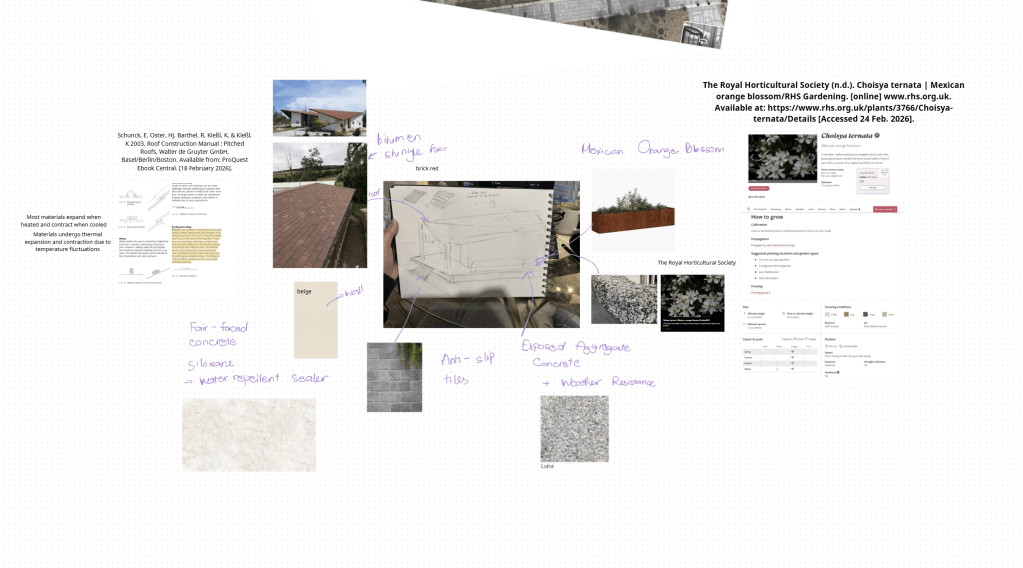
This is my visual research of Art Workshop group’s project.
 Phuong Vi Nguyen