
Week 5: PDP draft; meeting with my tutor from Ba course and Level 4 students
I wrote the PDP draft on Google Documents first because it allowed me to write not only on a computer but also easily work with it on my phone.
Before submitting this draft, I was very worried that I had done a terrible job. After receiving feedback from Bhavik that I had a good start, that eased some of my anxiety.
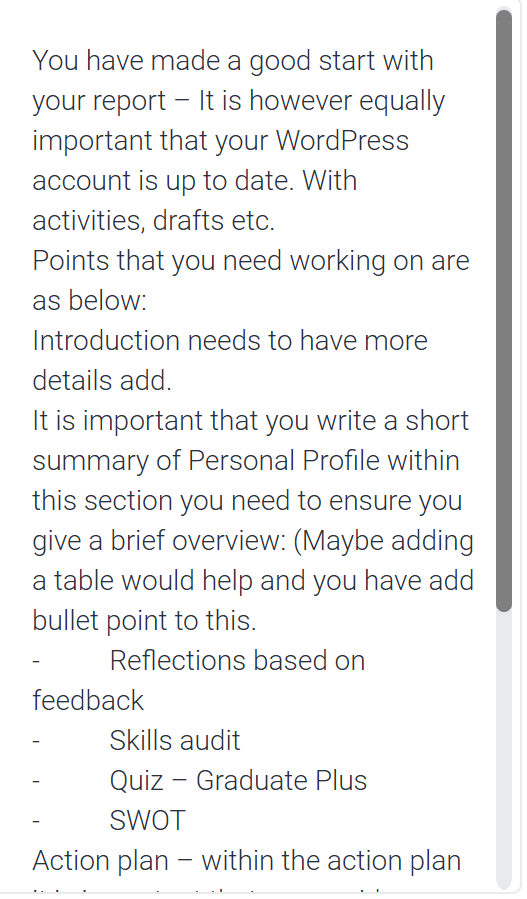
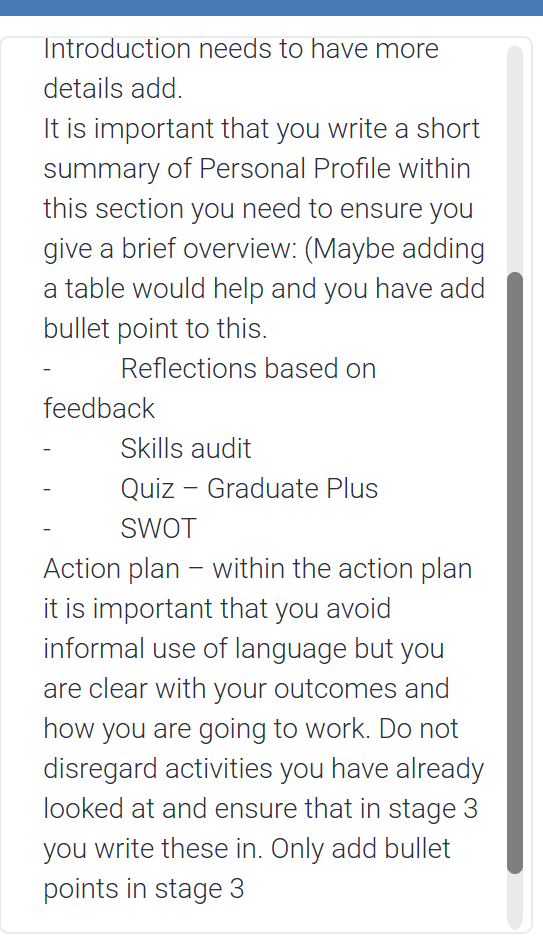
This is my feedback from Bhavik, he gave me a lot of good feedback that could help me to rewrite my PDP. And I also change some references in my Action Plan.
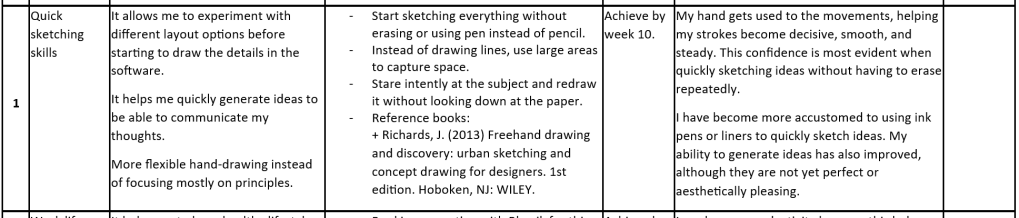
I used 2 resourse books for my quick sketching skills, but now I only use “Freehand drawing and discovery: urban sketching and concept drawing for designers”. Because I had read the other book but it does not suit what I want to learn so well.
This week, I had a meeting with my tutor from Ba course and level 4 students. I asked a lot of questions, mostly stemming from my anxieties before starting the Ba course, and they also gave me a lot of good advice, which helped me reduce my anxiety.
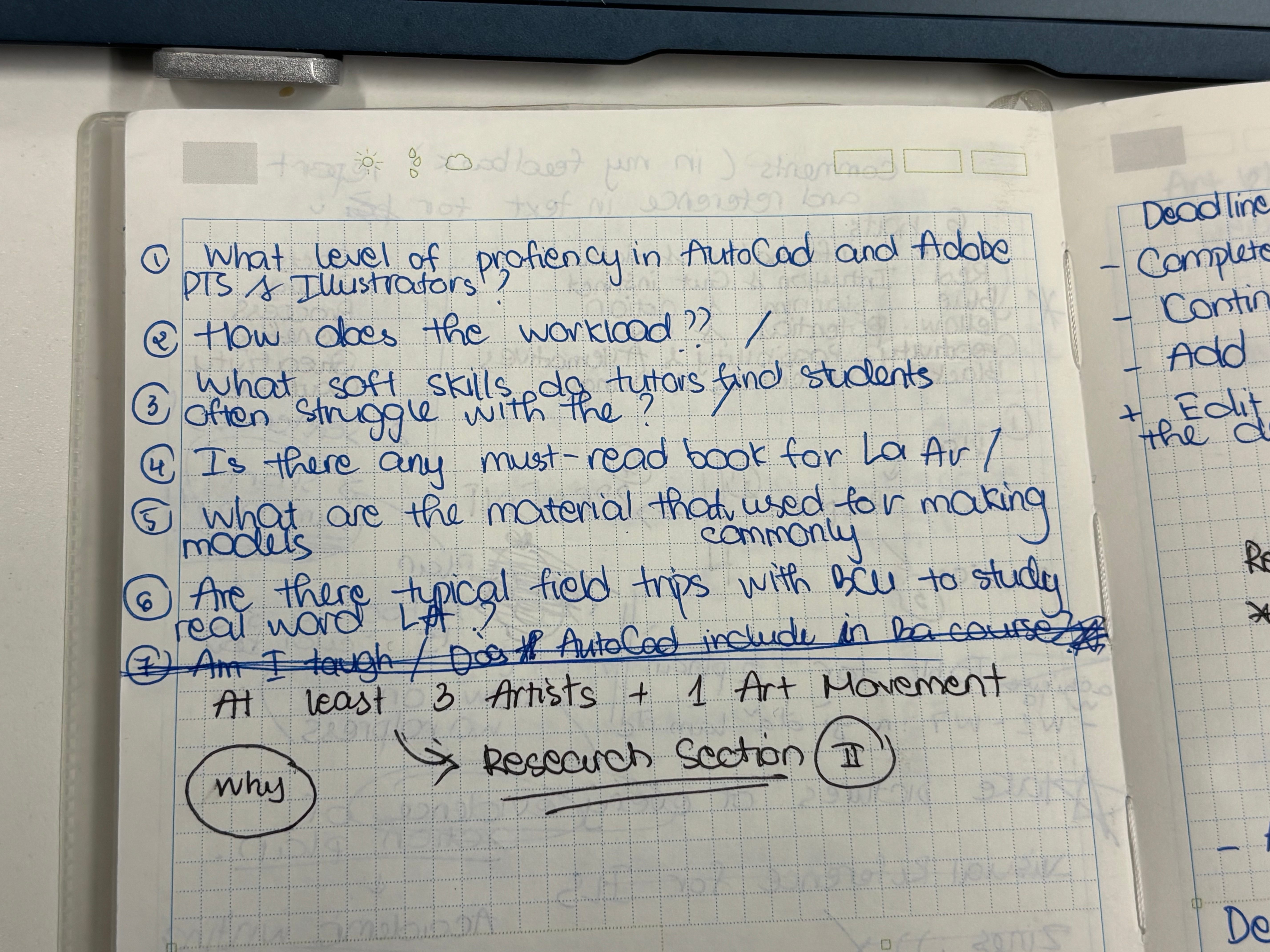
I listed some of questions that I could ask first. Because I am too worried to talk with a lot of people at the same time, so I made the list to, made me feel more ready to ask.
I used AI to sub my conversation, because WordPress dont let me upload MP4 file. And I also dont know why I can upload this conversation as a video I edit on Youtube.
Conversation
Student 1: I feel like they put the most simple stuff first, so it’s quite easy to get into it. Like, the skills module was really nice.
Student 2: I think first year helps you to, like, start thinking in a certain way in a sense, so that then when you go onto, like, the other years, it’s kind of like you already know what you’re doing and, like, you’re more familiar with the process as you go along. But first year’s really nice in the sense where it’s kind of like testing, playing around, like, when you’re doing your design process, what works for you, what doesn’t, things like that.
Tutor: Yeah, let me elaborate a little bit on that. You talk about AutoCAD, so as you mentioned, it’s quite nice from the student perspective. Some of you have zero knowledge about it, and you’re able to pick some stuff up. And because it’s Year 1 as well, we’re expecting Year 1 level, and gradually we’ll expect a lot more. The whole idea of it is we give you a platform to learn and a submission for you to implement.
Tutor: And then through this time, it’s not like we give you, like, one session or two, then you will learn it. You will learn it by yourself as well. In terms of tertiary education or higher education, the expectation is for it to be self-driven as well. To see a topic, for example, I cover this today, doesn’t mean that we’ll never—like, you will know straight away. You probably need to do more research on it. Similar to the skills as well, like riding a bicycle, you’re going to practice more, like CAD, you’ll be more perfect when you do more.
Tutor: And also, we have resources in terms of—have anyone been doing the online Moodle page? From BCU’s side, from Ray or from Luke, they have done a Moodle page with recordings of particular things that everyone asks, so that’s why they make a video of it. So you can learn through that in your own time as well, so you can use it. So the tutorial or when you’re going to present your work, you can show us back, and then we can feedback to you, say the digital group, to see if anything—I feel like so many students ask for this, can we make a video, or can you do a workshop for us? So it becomes quite flexible in terms of that.
Tutor: So every year we try to improve better and then, based from your work, from your experience, and become a stronger [resource]. So this year, the Moodle page of, like, digital help is—I can see a lot more support. And then Ray or Luke, they have more capacity to really help each discipline around as well.
Me: Because, like, I was studying AutoCAD by myself by watching YouTube videos, but it was really hard for me to start with, so I’m really confused and scared.
Tutor: Don’t worry about it, definitely, because people [are here to help].
Student 1: People are so helpful as well, they’re really encouraging.
Student 4: I literally had no knowledge and I passed the skills module with not really adding much to AutoCAD or anything, so it’s easily—if you’ve already started, it’s better than not having anything at all, but there’s still, like, help and support there for you, kind of thing.
Tutor: And then, expecting through the journey of these three years, you’ll pick it up as well. So for those people who finish and are high achievers, you still have your own pace to learn that, okay? So as other skills, Adobe skills, from Photoshop, InDesign, Illustrator, all these kind of things will be part of your, like, kind of natural things, natural language that you will—tools that you’re going to use through your journey. And also, other different programs as well, gradually be introduced to you. But the more programs, the basic stuff you know, you understand, “Oh, is it similar to this particular program but a different variation of those?” then you get it quite quickly on that later on.
Me: The next question is, like, what soft skills does—tutors find students often struggle with in the academic year?
Tutor: Soft skills?
Student 3: Yeah, soft skills you find that students often struggle with.
Tutor: Okay, maybe you share first, do you have any…?
Student 1: I was going to say, like, don’t worry about the software side of it, but if you wanted to practice something, I’d say drawing is a good way to go. There’s a girl in our group called Shanae who’s really good and always makes me feel—it’s not insecure, but she’s great at drawing. And I think, like, obviously they want you to do really well with the software digitally, but actually hand drawing, I think, carries a lot of weight. So if you’re nervous about it, just, like, practice a little bit of drawing of what you want to do, and I think you’ll build your confidence in that way.
Tutor: You talk about soft skills as in communication and all that?
Me: Yeah, soft skills besides the hard ones, like learning the program or doing the submission, but any, like, the soft bit that you struggle with or never knew that you needed?
Student 4: I feel like if there is anything that we don’t know, we always ask in the group chat, or we ask the lecturer, kind of thing. We’re always—we never—if we do get stuck, most of us are always stuck with something, as we’ve noticed, and we always ask, like, if someone’s like, “Oh, I’m struggling with this, is anyone else?” Everyone else says, “Yeah, I am as well.” And we always end up asking, kind of thing.
Student 1: I think the hardest part of this course is trying to, like—it’s more the confidence of it, like, trying to get your mind around there isn’t a right or a wrong. That’s the thing that I’m struggling with most. It’s not a black and white situation, there’s so much grey area of what you can do. Especially coming from, like, subjects in the past, like biology, that do have a right or a wrong answer, I do find it quite difficult coming into this course when I don’t have a right or a wrong.
Student 4: Yeah, I think it’s about being more open to, like, with just enjoying things that you say, if you like watching—reading magazines or, like, something that you’re interested in in normal life, just be open to a lot of things and be like a sponge with everything that’s going on outside of uni and outside of things to gain that extra bit of, like, ideas and inspiration because then, as she said, nothing’s right or wrong, so then when you come into the lessons, it’s kind of like, “Actually, I do quite like that, and how can that relate to what we’re doing?” kind of thing. So yeah.
Tutor: Okay, so maybe anyone would like to top up on that question? So, the soft skills. So, one thing is, like, we give you, like, programs and courses and books or material for you to, like, learn, but then the soft skills are, just what you said, it’s asking people, connect to people. One is connected to your classmates, okay? Some is, like, the relationship with the tutor. So you kind of mentioned quite nicely in this sense that you are able to establish a group that you can talk through things. This is part of the thing that’s quite important in terms of—of course, you don’t come in knowing everything.
Tutor: The whole point here is to learn something you haven’t tried, even done, or even known before. So you will learn through this, but then not just from us. We’re definitely not a primary school or secondary school, kind of casting information to you. It’s you through this journey, you pick it up from, like, different resources. Okay? I think I told our previous schools, I always think you come here, it’s like a gym membership. We train you a certain way, but then you have to come here to really go for it and try. If you don’t do it, just pay for membership, you will just look exactly like you were before, right?
Tutor: So something that you would like to have that mentality of going and trying new things. That maybe that’s part of the soft skills that you probably may not notice before. Because normally for a younger—like high school or primary school—”What are we going to do today, sir?” isn’t it? So more like feeding in. But in my final year students, I just go there and just talk. It’s rather than I give to them, they share whatever they find to me and then to convince their solution is better than last week. Okay? They may have found something then they think, “This will be more the reason why I make this now.”
Me: Because I’ve been struggling with, like, presentation skills. I’m not good at doing presentations, speaking in front of people, like I’m really scared. That’s why I asked.
Student 4: There’s a lot of that. There’s a lot of, like, presenting your ideas to everyone. But I feel like, well, I think as with a lot of us, we don’t feel intimidated in presenting with each other. Yeah, I think if you’re with a nice group that’s encouraging like we are, it’s a lot easier. Like last week, I sat at the back of the room, and then I came to the front, and you were like, “Oh, do we have to go to the front?” and I was like—encouraged you all to go to the front.
Tutor: That’s a good choice, I like it! So yeah, I can see—and it’s always good to have a little bit of pressure, but then you’re all doing fine, right? So, normally our external examiner do have comments like, you all guys are good at speaking. So gradually through the journey, you are able to present your idea. But of course, when you haven’t really started, you will feel like, “Okay, what’s my idea? What should I say?” But by the time you have prepared, think about it, and you practice a few more times, it’ll be, like, very smooth journey.
Student 4: But I found when I—the more I research things, the more I enjoy it and it’s something that I enjoy doing, the more it’s easier for me to then go and present what I need to present.
Student 1: If you’re passionate about it, it’s easier.
Student 4: And when you’ve done enough to be able to be like, “Actually, like the module that we’re doing now, I enjoy it because it’s a Chelsea Flower Show garden site,” and I’m like, “Yes, this—like, love it,” kind of thing. So then I can be like, “Right, I know what I’m doing, I know where I need to find all the information,” and then I can be like, “Oh, now I can regurgitate it to the class.” So it gives you more confidence in that way, kind of thing.
Tutor: Yeah, sometimes I use the word “sharing” rather than “presenting.” So in a way that you just, literally, because of what you have done, I just want to show what you have done. You feel very natural because you don’t need to remember because you did that, you just—just recording what you just said only, or you’ve been thinking. So in a way that, as you said, if you’re interested in what you’re doing and you’re quite passionate about it, it just comes quite naturally.
Student 2: I feel like in a group, like when we’re, like, learning a lesson in general as well, we share anyway on the table. So then sometimes it feels like you’re doing the exact same thing just standing up. But you get used to it because it’s like the whole thing that you share, yeah.
Student 1: I think it’s good that we, like, talk about it on the table as well, because, like, sometimes [Student 2] or Megan will say something that I haven’t thought of, like, about my project. It’s just really useful to, like, have the group connection.
Student 2: You sort of like bounce off each other.
Student 1: Yeah, because someone might say something and they’re like, “Wait!” and then someone will get another idea. And it’s also cool to see other people’s perspectives on the exact same thing. Like, you can all be set the same brief, but what you come out with is entirely different. And it’s really—because when I first came into this, I thought what I’m thinking, I think everyone’s going to do the exact same thing. But then you come together and everyone’s doing something completely different. It’s nice.
Student 2: Like at the moment, we’ve got a task to do it from, like, a song or a book or a movie, and, like, everyone’s is so different. It’s—it’s really, really cool to see.
Tutor: And also it’s good for us as well, because I want something new, I don’t want to see all the same piece of work again and again through the year. Of course, I want to be inspired at the same time as well, to give us passion, or other tutors, to really look into different ways of engaging you to extract the excitement, passion from you guys. I think that’s one good thing about doing landscape, or an art subject, it’s more fluid, it’s more inspiration, whereas if you were just doing English, then you’d get set, like, one book—like the one I’m doing for this one is Pride and Prejudice—you get set and it gets boring for the tutor to be like, “You’ve got to do an essay on Pride and Prejudice,” like, “No, no, no.” We want to make it more inspirational and everyone needs to be different.
Me: Is there any, like, “must read” book for landscape architecture before coming to the academic year?
Student 1: You do get sent a reading list before you join on the course.
Student 4: I think it’s more of, like, if you are looking at more, like—hand drawings, there’s loads—there’s a few books like for helping you to do your sketching of, like, the trees and plants and things like that. I would probably say recommend if you’re not very good at, like, hand drawings, practice your hand drawings and that will put you in good stead for the rest of—the rest of the course, kind of thing, because then it makes everything else easier. So it’s just more of, like, drawing than anything because you’ll get the books as and when the modules come out and as and when you’ve signed up for the course.
Student 4: But yeah, if there’s anything, it’s just more on, like, what you find inspiring with the different [things] in your normal life, that’s where you get much—just as much help than reading a specific book, kind of thing.
Me: And what are the materials that are commonly used for making models? Because I’m about to do my final outcome a couple of weeks after this, so I’m starting thinking about that.
Student 1: Cardboard. Lots of cardboard. And just, like, boxes, like Amazon boxes, whatever, like you can totally reuse it and recycle it. We used a lot of paper for our last module as well. So more basic things this year, I think. Paper, card.
Student 4: And if you—I’d say go onto Pinterest and search “landscape architecture models” and then it will—you can literally find some inspiration from there, like, “Oh, how can I use what I’ve got at home to create that model?” kind of thing. So I think it’s just—be experimental but don’t go over the top with it, kind of thing, but make sure that you’ve got your ideas into that model, kind of thing.
Me: Like, if you want to use other materials, where do you buy them?
Student 4: Go to the shop!
Tutor: Testing, like, “Where do you buy it?” Yeah, downstairs you can buy it. But, of course, collecting.
Student 1: But you can also resource it from around the building. Because people will have stuff that maybe they’ve only half-used, or off-cuts and stuff, and that will be a lot cheaper than you just buying everything new.
Me: Oh, yeah, that’s why I asked this question, because I’m scared of the price for making, like, the huge project.
Student 4: I used—I went downstairs and got a load of napkins, the paper napkins, and used them for one of my projects. So that was, like, free. So it’s just utilizing things that you’ve got at home that you’re already using.
Student 2: Downstairs in the workshop, at the back in the corner, they have lots of free materials. So they had a lot of foam that I took for my last project, I didn’t pay for any of it. And then what else do they have? I think they have some, like, card and—the last time I went it was covered in foam, I’ll be honest, but they have, like, lots of different materials.
Student 1: It’s just like all the leftover stuff that other people have used in their project. So you do get some, like—what materials do they sell in there? I think downstairs they have, like, metal and some wooden, some, but they have a bit of everything. But even if you buy it, it’s quite cheap material anyway, so none of it’s too expensive.
Tutor: Yeah, just to top it up, I think you highlighted quite nicely—the shops, walking around the building, collecting yourself like Amazon delivery, or you buy a fridge freezer, keep all the cardboard and stuff. Oh God, someone took all the knives from the canteen? The wooden—and then they used it.
Me: Because my tutor (Bhavik) always says to me that “Stop buying stationeries, stop buying these stuff”.
Tutor: And the workshop downstairs will be good because they do have a collection of stuff you can—the leftovers, like the foam, the wood, MDF, plywood, or a bit of the metals as well, or other things that you may come across in the light, I don’t know what happened there. But also the shop, even if you buy it, I think it’s a very, very good price. If you go outside to buy, probably it would cost double because the whole idea of the downstairs workshop, they’re selling the material as a material cost price basically. They’re not adding any top-up on this, they basically whatever they buy for 10 quid, they sell for 10 quid back to you guys. So if you want to make something yourself, do it because it’s way cheaper here than outside.
Tutor: And yeah, also online shopping as well. There’s a lot of choices. I know sometimes, I remember it was last year, the year before, someone was so into, like, Hobbycraft’s website, like, “Oh, it’s on sale, it’s on sale, do you want anything?” So share those ideas as a full-time student, you can have discounts on different places. I’m not sure, you let me know because you know your stuff. So do search for it. And in terms of what we’re asking you, we’re not, like, bombarding you with a lot of, like, money-burning elements. We’re trying to be—some of it could be—you need some sketchbook, need some pen, need some stuff, need some basic things to make a model, but we’re not asking you too much on this, but at the same time balance between the cost, but also you need some, like, attention to detail, the quality of outcome that we’re looking for as well. So a balance between.
Student 1: I was going to say also, like, in the labs and stuff, you can talk to the people who work there and they’re really lovely, and they will help you source things or find things, or talk about the right materials for you and your project. Like, if you’re unsure, please ask them, they’re really lovely people.
Me: And are there any, like, typical field trips for BCU to study, like, real-world experiment, the real environment?
Tutor: Trips or any site visit?
Student 1: We get loads of trips. I think there’s been two, I think, this year already. And they’re really interesting to hear from—at the last one we went on, we heard from the person who designed the space that we were in. It’s really interesting to hear from people who are actually in the trade.
Tutor: Field trip? Yes, we’re organizing, like, kind of from BA and MA level, sometimes we have a big coach together, everyone chips in a little bit of money, so then we can go a lot of places. And it takes a while to actually arrange the timing as well, and I don’t want to really just having a trip every month and it’s a bit too much, sometimes you need to really work on your work as well. So we try to have it more regularly, so we’re hoping for, like, just a few trips per year. But then at the same time, not just outside, but also inside, even just outside the building.
Tutor: Like today, where we’re going?
Student 1: I don’t actually know. They said it’s a construction site but I don’t know actually where it is.
Student 4: It’s in front of George’s place.
Student 1: What are you doing here then?
Tutor: Yeah, so even today, it’s a visit, it’s a site visit. So it’s not just reading slides and stuff here. You will go out, even you measurement outside, taking pictures outside, it’s also a site visit. Year 1 we tend to, for the course-related ones, we go for quite a local one so you can walk around without too much [travel]. Year 2 and 3—Year 3 can be quite flexible in terms of site choices, you can go further. Year 2 do have some places you may need to [use] public transportation. So some of the things is quite cost-related, some of it would be more the subject-related one. So you can become optional, some of it would be more compulsory on that. So the trips can be quite local, and can be quite national. And then depends on the year, we can go for international trip as well, because some year more people into go further away, so we will organize that too.
Me: And this is for my final outcome, I was—I’m thinking about, like, my theme journey. I picked the title for it, like “Landscape and Environment,” and I’m thinking about the technologies, like—that—the for the support title, like I want to explore and do and use some, like, technology, like, serve the human but also protect the environment. And I would apply it into, like, a public park. And I don’t know where to start with the places. Should I put the park in—
Tutor: Explain to me better because you’re talking about human and you want to look for—you’re designing a park.
Me: Yeah, but I don’t know how to start with it.
Tutor: Okay, so where is it? And how big is it?
Me: That’s why I’m asking, I don’t know where is it. I just—because I don’t—is like individual’s outcome, so I just have to pick and then—what should I pick?
Tutor: Okay, I will just—from understanding—you all can chip in as well, okay? So are you having a brief of designing something and you choose a park to redevelop and relate to human and beyond? Is it—no, no, I’m a question. So what are you trying to…?
Me: No, it’s like, we are given a theme journey, then we have to choose a title for our team, so I chose “Landscape and Environment.” For my big project is, like, I will design a park, but I don’t—I don’t know how to—way to put my park in. Is there any, like, countries still need or cities still need a park?
Student 1: Well, it’s up to you, really. If you think that there’s a park that you think, “Oh, actually, I could renovate this,” it’s a real-world example, and you have all the context that you need on, maybe the history of the place, and—like, are there any designs that you personally like that you could put into the park? Like Italian design or Japanese design? Like, get inspiration, because it’s all about what you want it to be.
Me: Okay, that’s all of my questions. Thank you for answering my questions.
They gave a lot of good advice, I felt less stress and worried for my Ba course. I did ask about the workload, but I loss that part. I remember that they said the workload is really huge but time managemant is one of the key to stay well while running on deadline. Including with other students from other course, they also said that time management is really important, because without planing your time, you should not do the course so well. This helps me prepare mentality and action plan to improve my study styles before entering the course.
There is a list of must-read books that they gave me. Maybe I can use that for my final outcome.
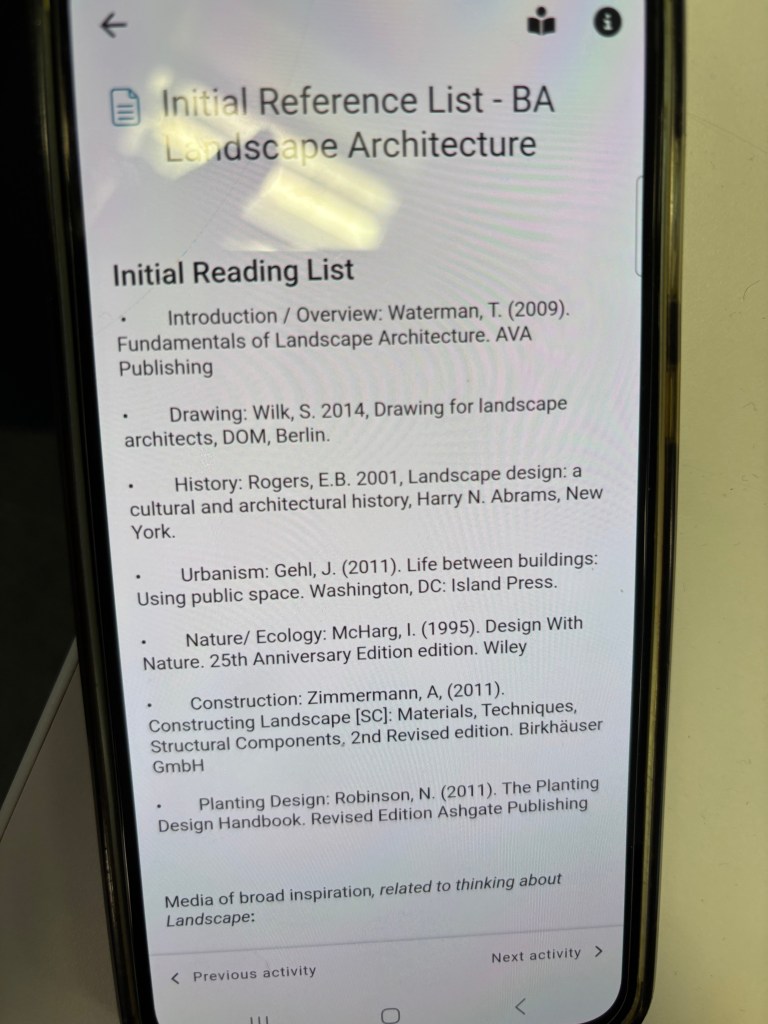
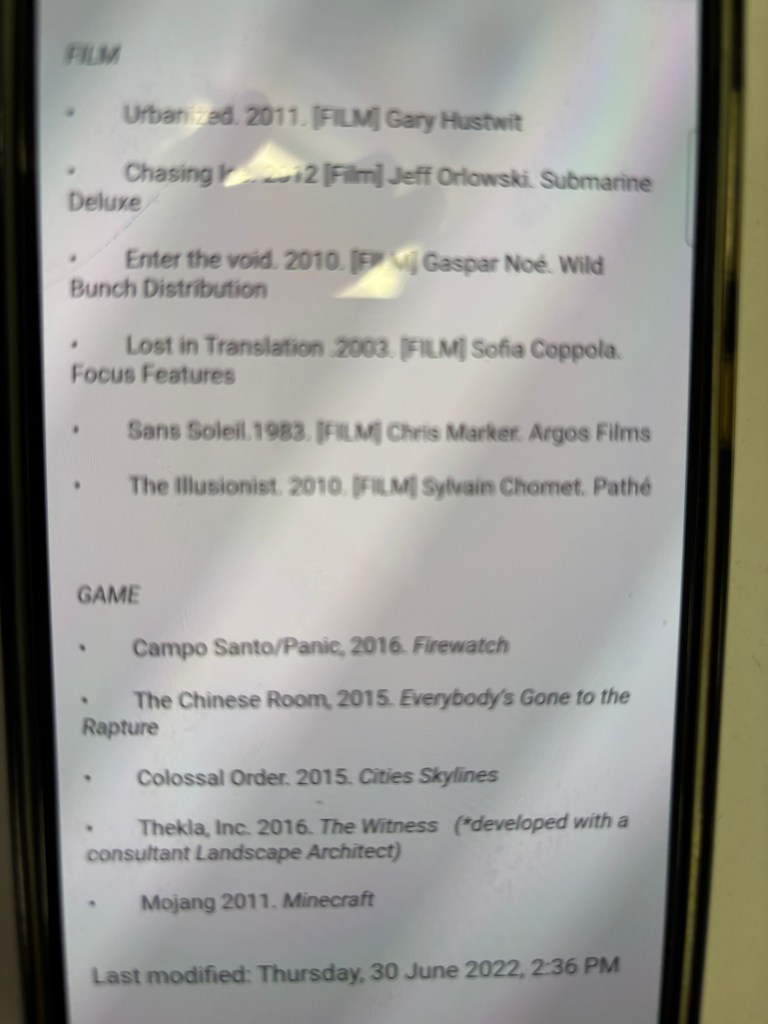
Landscape Architecture Challenge: Climate change
- Landscape Institute (2021)
The Landscape Institute’s 2021 report summarizes the role of landscape architecture in reducing greenhouse gas emissions and adapting to climate change. It references the policy frameworkand four action pillars: policy advocacy, internal progress, skills development, and member support. Core strategies include living roofs, mature trees, local food production, solar lighting, active‑travel networks, renewable‑energy integration, and nature‑based carbon sequestration. Four flagship case studies are highlighted: Tianjin Green Belt, UK coastal‑heritage risk mapping, Thamesmead regeneration, and Sutcliffe Park restoration.
Technologies highlighted in the Landscape Institute report: +Living roofs: green‑roof systems that provide insulation and reduce heating/cooling demand.
+Solar lighting & signage: photovoltaic‑powered fixtures that offset grid electricity.
+Ground‑source heat pumps: renewable‑energy installations placed in parks or open spaces.
+Sustainable Urban Drainage Systems (SUDS): engineered wetlands, permeable surfaces, and retention basins that mimic natural hydrology to manage flood risk.
+Interactive risk‑mapping tool (LUC for Historic England): web‑based GIS platform used to assess coastal‑heritage vulnerability.
+Renewable‑energy infrastructure: integration of wind, solar, or bioenergy assets within landscape and seascape planning.
+Nature‑based carbon sequestration: large‑scale planting, peatland restoration, and soil‑cover management to lock away CO₂.
=> There are a lot of technologies that Landscape Institute highlight that I think they are neccessary for developing the solutions for climate change.
- ASLA (2025)
Landscape Architecture 2040 outlines a climate‑positive, biodiversity‑focused roadmap that ASLA will roll out from 2026‑2030, aiming for a zero‑emissions and double‑sequestration future by 2040.
+Key levers: material choices, maintenance practices, planting strategies, and inclusive planning.
+Stakeholder web: 25 partner groups from contractors and engineers to NGOs, traditional‑knowledge bearers, and students collaborate through a clear matrix of roles and responsibilities.
+Tracking success: life‑cycle analysis, ecosystem‑service valuation, and equity indicators are used to measure emissions cuts, carbon capture, biodiversity health, and community outcomes, all aligned with UN SDGs and the Kunming‑Montreal biodiversity framework.
Purpose of this report:
+Create safe, inclusive public realms: the plan calls for resilient, accessible green spaces that serve every social strata, especially marginalized and Indigenous communities.
+Boost mental and physical health: by integrating nature‑based solutions that improve air quality, lower heat islands, and provide restorative, recreation‑friendly environments.
- The Global Engineering Design & Technology Journal (Sun, 2024)
This report traces the evolution of landscape architecture, from ancient gardens like Babylon’s Hanging Gardens and the formalism of Versailles, through 19th century pioneers such as Olmsted and Vaux, to today’s environmentally-focused practices that emphasize green infrastructure, resilience, and interdisciplinary collaboration. It highlights key figures, landmark projects, and shifting design principles that respond to urban growth, environmental degradation, and climate change.
Purpose
+ Offer a concise historical framework for students and professionals entering the field.
+ Highlight how design priorities have moved from symbolic expression to functional, smart climate solutions.
+ Show the role of collaboration (planners, engineers, ecologists) in creating sustainable, inclusive outdoor spaces.
Reference:
Landscape Institute (2021) Landscape for 2030: How landscape practice can respond to the climate crisis. London: Landscape Institute.
American Society of Landscape Architects (2025) Landscape Architecture 2040: Climate & Biodiversity Action Plan – Executive Summary for ASLA Members (2026-2030). Washington, D.C.: ASLA Fund
Sun, S. (2024). The Role of Landscape Architecture in Addressing Climate Change and Environmental Challenges. Global Journal of Engineering, Design & Technology, [online] 13(2), pp.1–2. doi: https://doi.org/10.35248/2319-7293.24.13.219.
 Phuong Vi Nguyen