
Week 3: Photography Theory
This week, we learnt how to use camera and some information about camera. I took many notes for this lesson because I do not have ability to remember digital things.
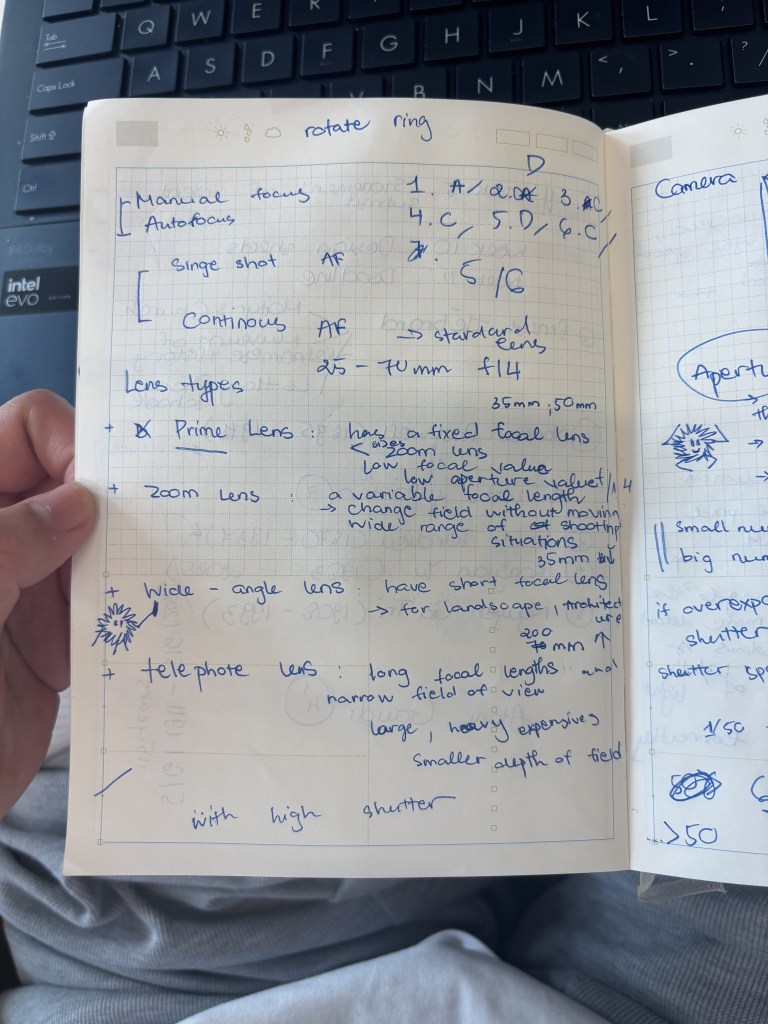
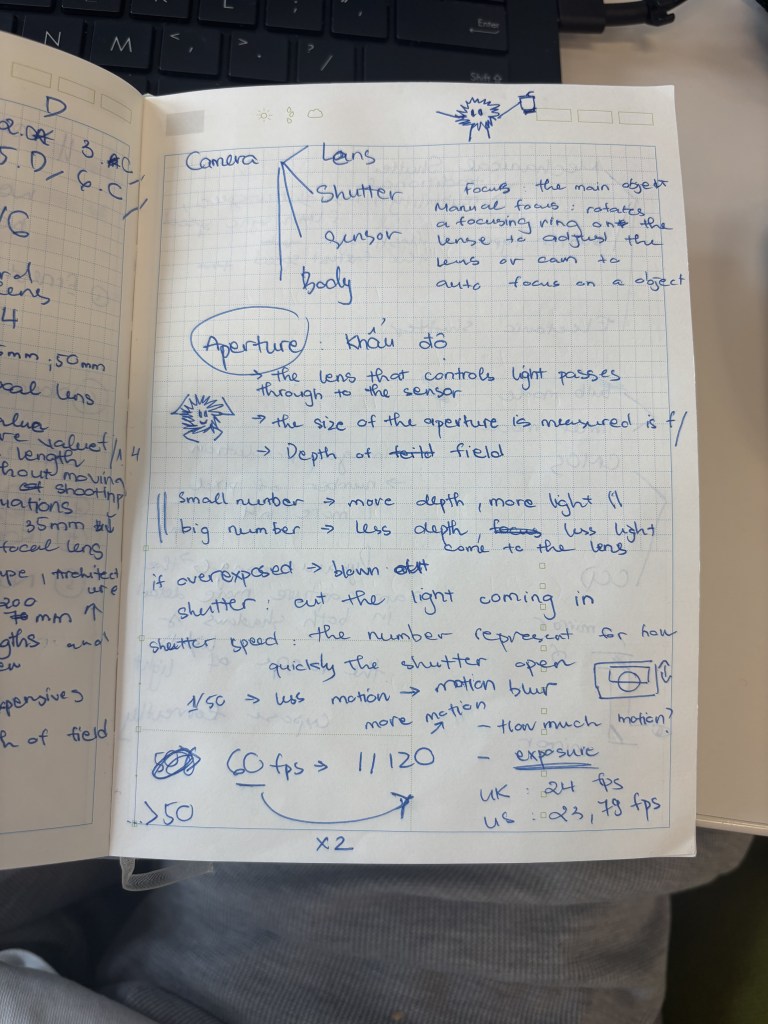
Aperture (Khẩu độ): the lens that controls light passes through the sensor. The size of the aperture is measured by f-number. A smaller number -> more depth and more light, a bigger number -> less depth and less light.
Focus: There are 2 types of Focus
- Manual focus: the camera has a focusing ring to be rotated on the lens to adjust the sharpness of the image.
- Autofocus (AF): Autofocus systhems use sensors and motors within the camera or lens to automatically focus on a subject. There are various autofocus modes, including single-shot (for stationary subjects), continuous (for moving subjects),…
Focusing modes:
- Single-shot AF: the camera focuses once when the shutter button is half-pressed and then locks the focus.
- Continuous AF: the camera adjusts the focus as the subject move.
- Manual focus
Lens types:
- Prime lens: has a fixed focal length (e.g., 35mm, 50mm, 85mm). They are typically known for their wider apertures, sharper image quality, and often smaller size compared to zoom lenses.
- Zoom lens: has a variable focal length (e.g., 24-70mm, 70-200mm), allowing the photographer to change the field of view without moving. This provides versatility for a wide range of shooting situations. Zoom lenses are usually more complex and often heavier than prime lenses and generally have a smaller maximum aperture.
- Wide-angle lens: have short focal lenghths (typically 35mm and below) and a wide field of view, allowing you to capture more of a scene. (can be used for landscapes, architecture, and group shots)
- Telephoto lens: have long focal lengths (typically 70mm and above) and a narrow field of view, magnifying distant subjects. They are large, heavy and expensive. They also have smaller depth of field. ( can be used for wildlife photography, sports photography, and portraits.
Shutter speed: the amount of time the camera’s shutter is open, allowing light to reach the sensor. It is a crucial element in controlling exposure. Faster shutter speeds freeze motuon, while slower speeds allows for motion blur.
Shutter typers:
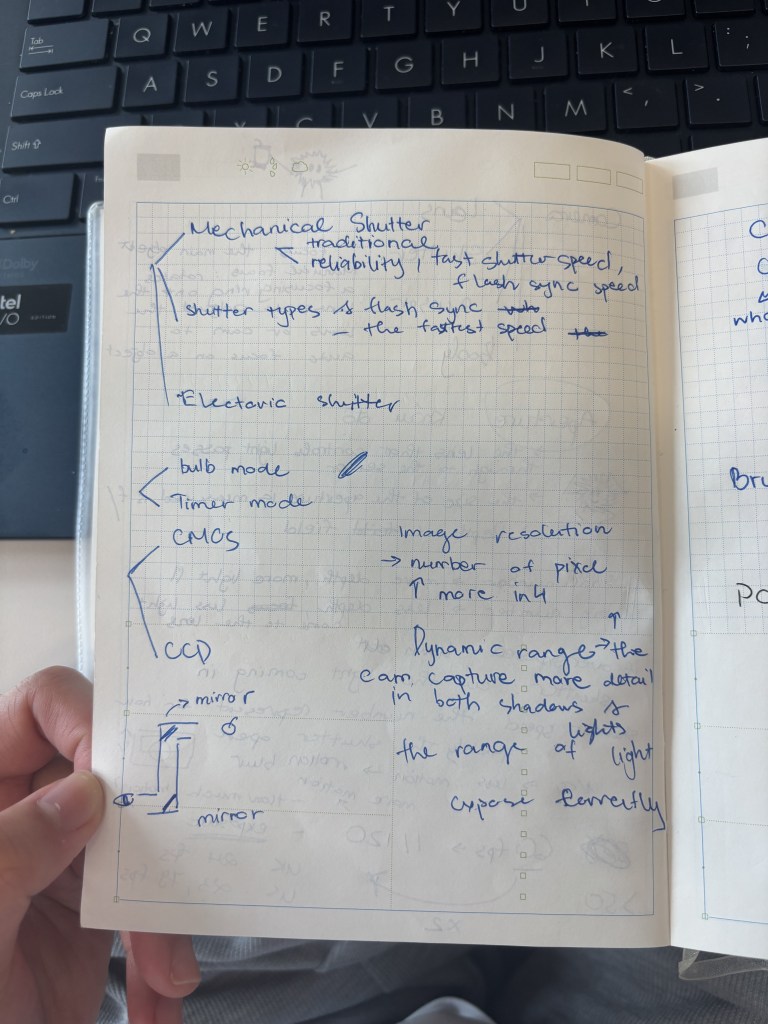
- Mechanical Shutter: is the traditional type of shutter, consisting of physical blades that open and close to expose the sensor to light. It is known for its reliability, fast shutter speeds, and often a flash sync speed.
- Shutter Types and Flash Sync: •The mechanical shutter typically has a “flash sync speed,” which is the fastest shutter speed the camera can use while still synchronizing with a flash. The electronic shutter sometimes does not have a flash sync speed.
- Electronic Shutter: uses electronic signals to activate the sensor, effectively simulating the action of a mechanical shutter. It offers the potential for extremely fast shutter speeds, silent shooting and can be beneficial in certain situations.
Shutter modes:
- Bulb mode: mode allows the shutter to remain open for as long as the shutter button is pressed. It is used for very long exposures, such as capturing star trails, or very low-light conditions.
- mode allows a delay before the shutter opens. This is useful to avoid camera shake when using a tripod and you want to take a picture without touching the camera.
Sensor types:
- CMOS (Complementary Metal-Oxide Semiconductor: Bán dẫn oxit kim loại bổ sung): sensors are the most common type of sensor in modern cameras, known for their fast-processing speeds, lower power consumption, and often lower cost compared to CCD sensors
- CCD (Charge-Coupled Device: Thiết bị ghép điện tích): slower processing speeds and higher power consumption.
Image Resolution: the number of pixels (picture elements) that make up the image, typically measured in megapixels (MP).
Dynamic range: is the ability of a sensor to capture the range of light levels from the darkest shadows to the brightest highlights in a scene. A higher dynamic range means the sensor can capture more detail in both the shadows and highlights
Mirror system: found in Digital Single-Lens Reflex cameras, the mirror system uses a mirror and prism to reflect the light from the lens up to the optical viewfinder, allowing the photographer to see exactly what the lens sees. When the shutter button is pressed, the mirror flips up out of the way to allow light to reach the sensor.
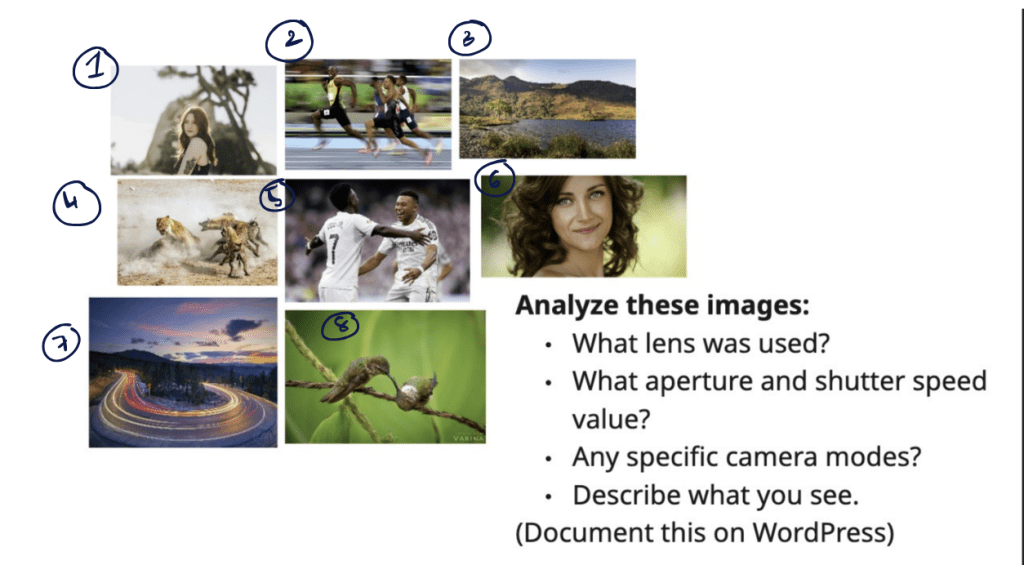
Image 1: A portrait of a woman outdoors with rocks and trees in the background. The woman is in sharp focus, while the background is softly blurred to help her stand out.
- Lens:It could be a prime lens (offering the advantages of a wide aperture for background blur and sharp image quality) or a telephoto lens (providing a shallow depth of field, making it suitable for portrait photography).
- Aperture: Wide (f/1.8) to create the shallow depth of field that blurs the background.
- Shutter Speed: Fast enough to allow for hand-holding the camera and freezing minor movements (1/200s or faster).
- Specific camera modes: Single-shot AF, because the is a stationary subject..
Image 2: Track athletes running. The runners are relatively sharp, but the background is blurred in a horizontal direction, conveying a strong sense of speed.
- Lens: A telephoto lens (e.g., 70-200mm) to get a close-up view of the athletes from the sidelines.
- Aperture: Mid-range (f/8) to keep a reasonable amount of the subject in focus while panning.
- Shutter Speed: Relatively slow (e.g., 1/30s to 1/60s). Moving the camera to track the subject while the shutter is open, which blurs the static background.
- Specific camera modes: Continuous AF allows the camera to continuously adjust focus to track moving subjects (such as athletes).
Image 3: A scenic landscape featuring a lake, trees, and mountains. Everything from the immediate foreground to the distant mountains is in sharp focus.
- Lens: A wide-angle lens (16mm to 35mm) to capture a broad field of view.
- Aperture: Narrow (f/8 to f/16) to create a deep depth of field, ensuring maximum sharpness throughout the entire scene.
- Shutter Speed: depending on the daylight, but likely moderately fast (1/100s) or slower if mounted on a tripod.
- Specific camera modes: Use Single-shot AF (or manual focus for precise sharpness adjustment) since the subject is static.
Image 4: Lions and hyenas clashing in a dusty environment. The intense action is completely frozen in time, capturing the animals mid-movement alongside suspended dust particles.
- Lens: A telephoto lens (300mm to 600mm) to capture dangerous wildlife safely from a distance.
- Aperture: Wide to mid-range (f/4 or f/5.6) to let in enough light for a fast shutter speed while keeping the interacting animals in focus.
- Shutter Speed: Very fast (1/1000s or faster) to perfectly freeze the rapid, erratic motion.
- Specific camera modes: Continuous AF to maintain focus on animals engaged in a fierce scuffle (moving subjects).
Image 5: Two football players celebrating. The players are crisp and isolated against a blurred, compressed background of the stadium crowd.
- Lens: A long telephoto lens (200mm to 400mm), which compresses the background and brings distant subjects close.
- Aperture: Wide (f/2.8 to f/4) to blur the distracting crowd and keep the viewers’ focus entirely on the players.
- Shutter Speed: Fast (1/500s to 1/1000s) to freeze their celebratory movements.
- Specific camera modes: Continuous AF ensures precise focus as players run towards each other.
Image 6: A tight headshot of a smiling woman. The background is completely smoothed out into an indistinct wash of color, drawing total attention to her face.
- Lens: A portrait telephoto lens (85mm or 135mm).
- Aperture: Very wide (f/1.4 or f/1.8) for an extremely shallow depth of field.
- Shutter Speed: Standard for portraits (maybe 1/160s to 1/250s).
- Specific camera modes: Single-shot AF (for stationary subjects).
Image 7: A mountainous road at twilight or night. Instead of distinct cars, there are continuous red and white streaks of light tracing the curves of the road.
- Lens: A wide-angle lens (14mm to 24mm) to capture the sweeping curves of the landscape and the sky.
- Aperture: Narrow (f/8 to f/11) to maintain sharpness across the landscape and extend the necessary exposure time.
- Shutter Speed: Very slow/long exposure (10 to 30 seconds). The camera must be on a tripod. The shutter stays open long enough for moving cars to travel through the frame, recording only their lights.
- Specific camera modes: Manual focus often has to be used because the autofocus (AF) system struggles to operate accurately in the dark.
Image 8: A macro or close-up shot of two hummingbirds interacting on a branch. The birds are pin-sharp, while the background is a smooth, creamy green blur.
- Lens: A macro lens or a telephoto lens (100mm Macro or 200mm) to get detailed shots of very small, skittish subjects.
- Aperture: Wide (f/2.8 to f/4) to blur the foliage behind them.
- Shutter Speed: Extremely fast (1/2000s to 1/4000s) to freeze the incredibly rapid beating of hummingbird wings.
- Specific camera modes: Continuous AF to track the continuous movement of hummingbirds.
I think these learning about camera can help me become a good photographer which I can take photo of landscape or my models in the future.

