
Week 5: Further research and Research Essay
Vietnamese Material: Acording to Vuong et al. (2019)
- Typical Indigenous Materials: Bamboo, wood, straw, and mud are indigenous building materials utilized where Western and traditional architectural styles intersect. Houses were typically constructed from wood, whereas commemorative structures were usually built of brick.
- Material Use in Decoration and Facades: Vietnamese architectural ornamentation was primarily crafted from ceramics. Stone was rarely used for house facades; instead, it was chiefly employed for sculpting sacred symbolic figures.
- Distinctive Construction Techniques: The Vietnamese developed a unique mortar blend, combining honey, lime, paper pulp, and sugarcane residue to create a binding agent suitable for construction.
To sum up, architecture during the period 1920–1945 was characterized by a strong hybridization, with building materials serving as a cultural bridge. It involved a parallel combination of indigenous, traditional materials such as bamboo, wood, thatch, and mud and the industrial, urban materials introduced by the French, including iron, concrete, roof tiles, and bricks. Moreover, the Indochine architectural style derived its distinctively local character precisely from the continued use and celebration of materials like wood and bamboo.
This brought me an idea of using bamboo in for the material choice of my project. The reason for this that bamboo is considered as a cheap and environmentally friendly material, suitable with the condition of Jardin d’agronomie tropicale when I am not allowed to concrete the site and intervene the green space.
Reference:
Vuong, Q.-H., Bui, Q.-K., La, V.-P., Vuong, T.-T., Ho, M.-T., Nguyen, H.-K.T., Nguyen, H.-N., Nghiem, K.-C.P. and Ho, M.-T. (2019) ‘Cultural evolution in Vietnam’s early 20th century: A Bayesian networks analysis of Hanoi Franco-Chinese house designs’, Social Sciences & Humanities Open, 1, p. 100001. Available at: https://doi.org/10.1016/j.ssaho.2019.100001.
Other Cultural Influences in Vietnamese’s Art or Architecture
As I mentioned in Ernest Hebrard’s works showing that he was influence by Beaux-Art(European art) in his project in Vietnam. Also, acording to other resource I found Art-deco also influenced Ernest and many artists who was sent to Vietname in 1920s. Therefore, I will explain what is Beaux-Art and Art-deco elements in Vietnamese Art or Artchitecture.
Also, Vietnam is a Sinosphere country from many years ago before being invaded by French in 1884. So I will also explain what was influenced by Chinese culture in Vietnamese Art and Artchitecture.
Beaux-Art
Beaux-Art architecture is classical, luxury style that emerged in Paris in the 19th century and spread to the United States and other parts of the world. Beaux-Arts architecture draws inspiration from ancient Greek and Roman architecture, as well as the grandeur of the Renaissance and the French and Italian Baroque periods which stritly adhered to principle such as symmetry and elaborate decorations.
Charateristics of Beaux-Art:
- Classical motif: directly inspired from ancient Greece and Rome, design symmetry laid is the foundation of Beauxe-Art style structures. Other classical revival elements included columns, triangular pediments, bas-reliefs, and arcades (covered walkways).
- Decoration: Influenced by the French and Italian Renaissance and Baroque periods. Decorative details are used to convey the building’s purpose and identity.
- Luxurious and modern materials: Luxurious marble and limestone are combined with materials that were modern for the time, such as cast iron and large glass panes (The materials reflects the wealth).
- Impressive scale: A raised ground floor is a common feature of many Beaux-Arts buildings.
- Arched Windows and Doorways: Beaux-Arts structures incorporate arched windows and doorways to create a sense of balance. These harmonious shapes also draw the eye upward, accentuating the building’s majestic grandeur.
- Grand Staircases: Lavish entrance with dramatic staircases serve as the building’s point of entry.
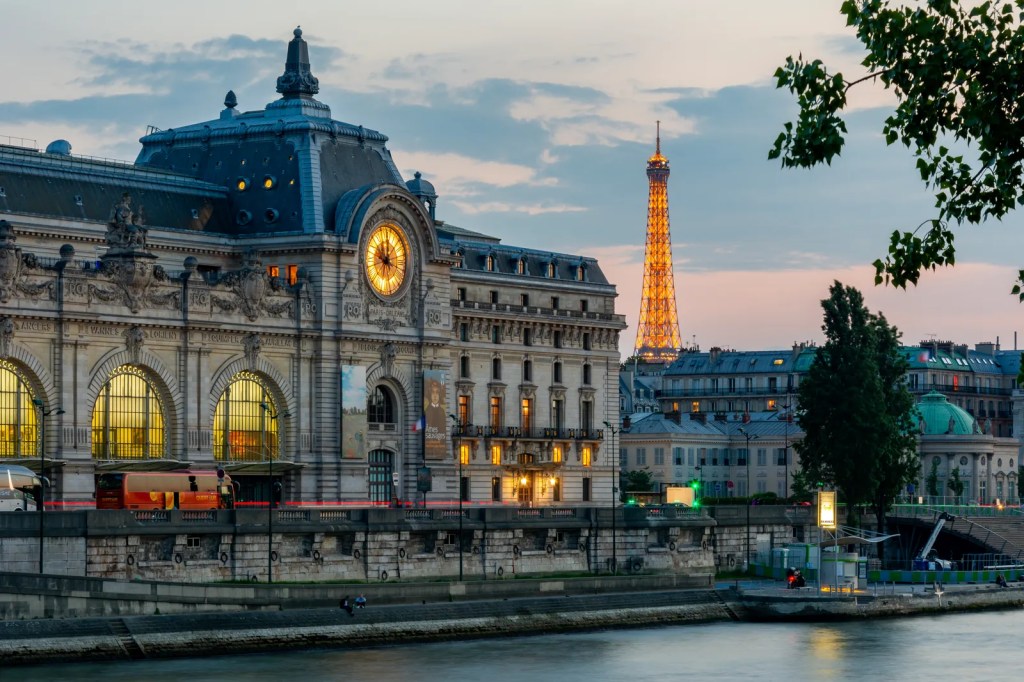
Musée d’Orsay in Paris.
This building served exactly the Beaux-Art style when looked from the outside. With symmetry strutruce, the large clock and the large arched windows and stone garlands and classical-style porticoes showing the luxury and classical vibe of the building.
Because Ernest Hebrard was 20th century artist, he was influenced by many features of Beaux-Art Architecture and combined it with Vietnamese features to create the Indochina style as we can see in the Louis Finot museum I analysis before. Also, at that time Art-Deco was also a famous art movement which influenced Hebrard in Iron Wrought decorations in Hanoi.
My analysis
From Musée d’Orsay in Paris, I can see the different between the Beauxe-Art in Europe and it influenced in Vietnam in the past. The symmetry of the building made me feel it look bigger. The most different part is the roof of the building while the Hernest’s work in Vietnam using the two-tiered roof, Musée d’Orsay constructed using slate slabs. . Additionally, the huge clock which has the light illuminated in the facade of the builidng play a role of focal point of the building which draw people eyes.
Art-Deco
Art Deco was a movement in decorative arts and architecture that originated in Western Europe during the 1910s and 1920s.
Art Deco objects typically feature simple, clean lines and a streamlined appearance; decorative motifs that are geometric or stylized versions of iconic forms such as flowers, animals, and sunbursts; and the use of man-made materials including plastic, Vita-glass, and reinforced concrete often combined with natural materials like jade, silver, ivory, and chrome.
Geometric patterns are the most prominent feature of the wrought-iron door and window designs that appeared in Hanoi from the 1920s onwards. This was incorporated with Chinese influences on Vietnamese architecture created a distinct difference between this architectural movement in Vietnam and the one in Europe at the time.
Chinese Influences
Chinese culture has deeply permeated Vietnam over the centuries, a fact clearly reflected in the facades of Hanoi’s old houses through a system of symbols drawn from Confucianism, Taoism, and Buddhism.
+ Confucianism: The influence of Confucianism is evident in motifs such as dragons and traditional scrolls, and particularly in the use of Chinese characters on signage or at building entrances. The presence of Chinese characters on facades is considered an aesthetic highlight of houses built prior to 1945.
+ Taoism: Characterized by decorative details such as cloud patterns, bagua mirrors (used to ward off evil spirits), and Yin-Yang symbols. Additionally, the architecture incorporates traditional symbols of good fortune such as the gourd, ancient coins, the Four Sacred Animals, and characters representing Longevity , Fortune , Happiness, and Blessings. The chrysanthemum, a symbol of Chinese origin, also represents Taoism.
+ Buddhism: Despite its deep roots in India, Buddhist decorative motifs such as the lotus flower, the peach, and the Wheel of Reincarnation appear prominently on house facades, often bearing a distinctively Chinese stylistic influence.
-> These influences are evident in the wrought ironwork and building facades dating from the pre-1945 period, which incorporate Western Art Deco elements.
Besides, the yin-yang tile roof is another element of Chinese architecture that has strongly influenced Vietnamese architecture.
Yin-Yang roofing tiles consist of two types, facing tiles (Yang) and facing tiles (Yin) tiles, interlocked to create a distinctive undulating roof surface. This structure not only enhances ventilation and water drainage but also serves as an Eastern symbol of Yin-Yang harmony; representing opposing yet complementary forces that create a balanced whole.
Yin-yang roof tiles, originating from traditional Chinese architecture, found their way into Vietnamese living spaces at a very early stage.
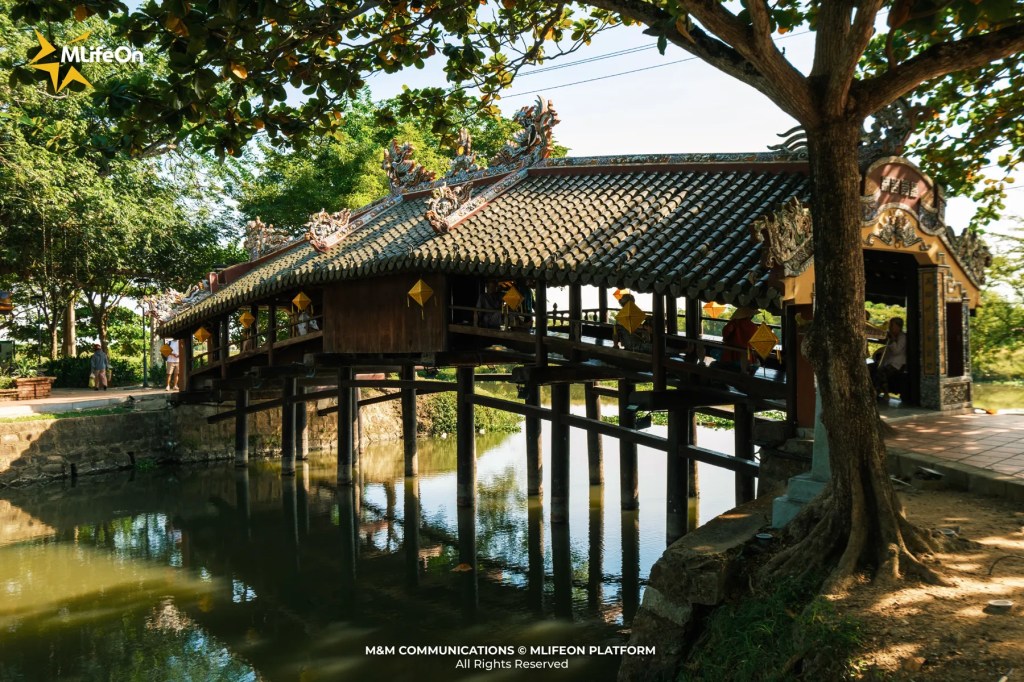
Yin-Yang tiled roof at Thanh Toan Tile Bridge, Hue City
(built in the 18th century)
The yin-yang tile roof imparts an air of antiquity, elegance, and grandeur. The continuous repetition of undulating curves creates a graceful, fluid rhythm across the entire structure.
The bridge is supported by a series of sturdy cylindrical piers anchored deep into the water. These load-bearing structures elevate the graceful wooden framework above flood levels, creating a striking contrast between the verticality of the piers and the horizontal span of the bridge. Crafted from dark-toned timber, the structure supports both the walkway and the substantial roof. Exposed joinery details highlight traditional construction techniques. The expansive, gently curved roof is clad in traditional ceramic tiles (yin-yang tiles), while the roofline is distinguished by elaborate, undulating ornaments, featuring dragons or floral motifs, that carry spiritual significance and serve to protect the structure.
I have concluded that Vietnam has been influenced by various cultures throughout its history. These elements have been “Vietnamized” and adopted as part of the country’s cultural identity. This also demonstrates that the cultures introduced to Vietnam did not displace one another; instead, they harmonized and have coexisted to this day.
Reference:
Britannica (2025). Art Deco | Definition, Characteristics, History, & Facts. [online] Encyclopedia Britannica. Available at: https://www.britannica.com/art/Art-Deco [Accessed 28 July 2026].
Huynh, G. (2025). YIN-YANG TILE ROOF – THE OLD SOUL REMAINS FOREVER. [online] MLifeOn. Available at: https://mlifeon.com/en/articles/yin-yang-tile-roof-the-old-soul-remains-forever/ [Accessed 28 July 2026].
Kliest, N. (2025). What Is Beaux-Arts Architecture? The Story Behind the Signature Style of ‘The Gilded Age’. [online] Vogue. Available at: https://www.vogue.com/article/what-is-beaux-arts-architecture [Accessed 28 July 2026].
Vuong, Q.-H., Bui, Q.-K., La, V.-P., Vuong, T.-T., Ho, M.-T., Nguyen, H.-K.T., Nguyen, H.-N., Nghiem, K.-C.P. and Ho, M.-T. (2019) Cultural evolution in Vietnam’s early 20th century: A Bayesian networks analysis of Hanoi Franco-Chinese house designs, Social Sciences & Humanities Open, 1(1), p. 100001. Available at: https://doi.org/10.1016/j.ssaho.2019.100001.
Golosova, E.V. and Chu, H.M. (2019). The gardens and architecture of the imperial burial complexes of Vietnam as a result of the influence of Chinese culture on the countries of Woutheast Asia. [online] Amazonia Investiga, 8(21), pp. 491–499. Available at: http://www.udla.edu.co/revistas/index.php/amazonia-investiga.[Accessed 28 July 2026]

